Vatsal
A trust layer for hotel listings that ensures what guests see
is what they get.
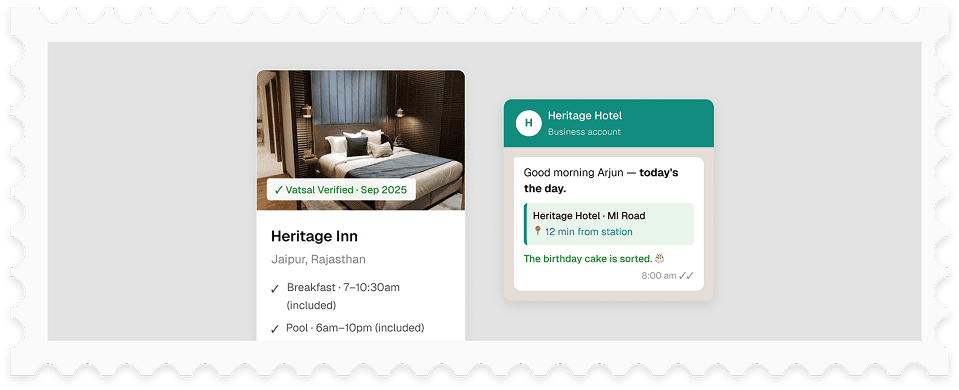
Overview
Vatsal standardises and verifies hotel information
across platforms to reduce expectation mismatch
and build booking confidence. It shifts verification
from a manual effort users do themselves to a
system responsibility built into the listing.
Project type
Academic · Omnichannel Design
My role
UX · System Thinking · Product Thinking
Duration
4 weeks · May 2025
Problem
Booking a hotel is fast. But it isn't reliable.
The problem isn't availability.
It is trust in information. The gap between
what's listed and what guests actually receive.
What guests arrive to find
01 · Photos
🌅
OTA photo
≠
Actual room
Different angle
Rooms different from photos
OTA images are often old,
curated, or show different room
categories than booked.
expectation mismatch
02 · Services
✓ Breakfast included (OTA)
✗ Not included (at hotel)
Services not as expected
Inclusions listed on OTAs often
don't match what staff at the
hotel actually offer.
broken promise
03 · Staff
Guest shows
OTA listing
Staff has no
record of it
Staff unaware of promises
Front desk staff often have no
visibility into what was listed
on the OTA at time of booking.
no source of truth
04 · User response
OTA A
OTA B
Reviews
Call hotel
Manual cross-checking
Users juggle across platforms and often call the hotel directly just to feel confident.
user does the work
Research
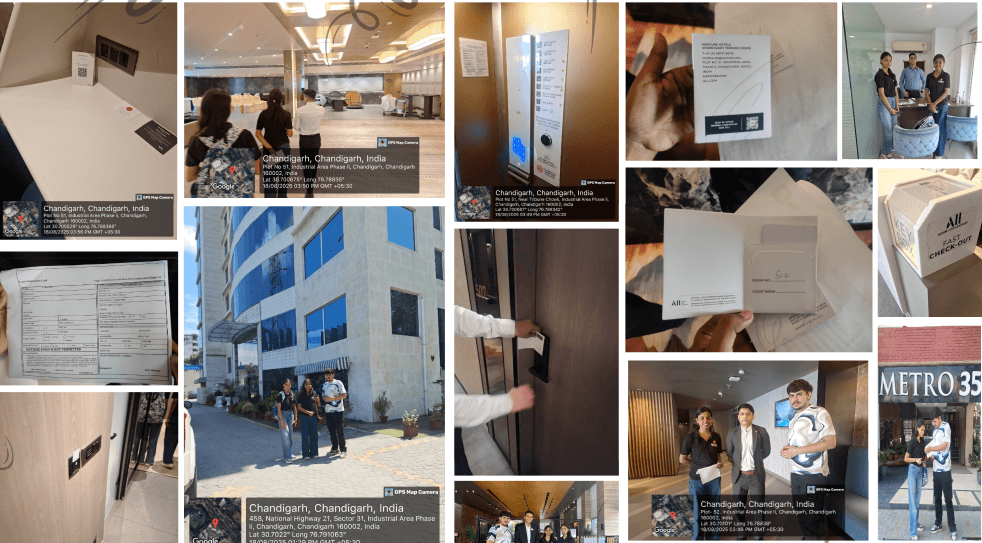
To understand the trust gap in hotel bookings, mapped the full guest journey from browsing OTA listings to arriving at the front desk looking for where information breaks down.
What users actually do
Don't trust OTA listings directly — they
cross-check across multiple platforms
before deciding
Call hotels before booking to verify
what's included — a workaround that
shouldn't exist
Use reviews to validate photos and claims
— not just to rate experience quality
How Might We?
How might we help hotel guests
trust what they see before booking,
without needing to verify it
manually?
Long descriptions are ignored. Quick, visible signals are what guide
decisions.
Key Insights
Four things research made clear — and each one pointed
to the same fix.
1
Trust is built outside the platform, not
within it — users go elsewhere to verify.
2
Users verify manually because the
system doesn't do it for them.
3
Mismatch breaks trust more than poor
quality — small gaps feel like deception.
4
Clarity matters more than feature
richness. Users need quick, scannable
signals.
Opportunity Areas
From research, three key opportunities emerged.
Opportunity 01
Make information verifiable
Ensure what users see on OTAs
can be trusted. Not just by adding
a badge — but by actually
verifying the content behind it on
a regular schedule.
Opportunity 02
Reduce manual verification
Remove the need for calls and
cross-checking. If the listing is
reliable, users don't need to go
elsewhere. Every workaround is a
UX failure.
Opportunity 03
Standardise
communication
Make information consistent
across every touchpoint — OTA,
email, WhatsApp, and at the front
desk. The same truth,
everywhere.
Solution
Vatsal is a verification layer that sits between hotel property data and
guest-facing platforms, ensuring the same verified truth appears on every channel.
System architecture
Hotel PMS
Property data
Vatsal Layer
Verify · Structure · Distribute
verification engine
OTA Platforms
MakeMyTrip · Booking
User
Books with clarity
WhatsApp confirm
raw data
verified
published
MVP Features
01
Verified Photo System
Time-stamped, room-specific images. Each photo is tagged to
an exact room type and carries a verification date that decays
quarterly — so stale images can't pass as current. The decay
mechanic creates the accountability.
Why: Users don't trust visuals and cross-check externally.
02
Structured Information Layer
A clear three-part breakdown: what's included, what's paid, and
what the policies are. No walls of text. Scannable, categorised,
and verified at the source — not written by the hotel's marketing
team.
Why: Users miss critical details buried in long descriptions.
03
Vatsal Verified Badge
A visible trust signal on listings. Four states: current, ageing,
stale, and unverified. The badge communicates not just that
verification happened — but when. A badge from 18 months ago
is worse than no badge.
Why: Users rely on quick signals for booking decisions.
04
WhatsApp Confirmation
A pre-arrival summary sent to the guest's phone with the
verified details of their specific booking — room type, confirmed
inclusions, check-in time, and any paid extras. Replaces the call
they were about to make.
Why: Users call hotels to confirm what they booked.
How it Works?
From listing to arrival, verification moves from user effort to system responsibility.
From listing to arrival
01
Hotel uploads data
Room info, photos, service details, policies
Hotel
02
Vatsal verifies and structures it
Photos tagged · inclusions confirmed · badge assigned
System
03
Information pushed to platforms
Same verified data on all OTAs and hotel website
System
04
User books with clarity
Sees verified badge, structured inclusions, accurate photos
User
05
WhatsApp confirmation sent
Verified booking summary · no call needed
User
Screen Design
Kora Kagaz is a connected service ecosystem.
OTA listing
Info layer
WhatsApp confirm
Verified badge
OTA Listing — Before & After Vatsal
The same hotel listing — before verification is applied, and after. The difference isn't
more information. It's structured, trustworthy information.
Before Vatsal

No verification
Heritage Inn · Jaipur
MI Road, Pink City · 4.1 ★ (218 reviews)
₹2,400
/ night
Enjoy a comfortable stay with complimentary breakfast and access to
our swimming pool. Free parking available. City view rooms subject to
availability. Early check-in may be arranged on request.
Photos may not reflect current room condition
Guest reads this, isn't sure if breakfast is really included, whether parking
costs extra, or which rooms actually have city views. Opens Google Maps.
Checks another OTA. Calls the hotel.
After Vatsal
✓ Vatsal Verified · Sep 2025
Heritage Inn · Jaipur
MI Road, Pink City · 4.1 ★ (218 reviews)
₹2,400
/ night
✓
Breakfast included (7–10:30am · Heritage Eatery)
✓
Pool access (6am–10pm)
✓
Wi-Fi (all areas)
₹
Parking · ₹200/night
₹
City view rooms · ₹400 upgrade
Guest reads this, knows exactly what's free and what costs extra. No
ambiguity. No need to call. Books immediately.
Structured Information Layer
The full verified information panel. Three sections, always in the same order. Scannable
in under 10 seconds.
Heritage Inn · Room 307
✓ Verified
Included with your stay
🍳
Breakfast
7–10:30am
✓
🏊
Pool access
6am–10pm
✓
📶
Wi-Fi
All areas
✓
💪
Fitness centre
6am–9pm
✓
Available at extra cost
🚗
Parking
₹200/night
🌆
City view upgrade
₹400
✈️
Airport pickup
₹1,200
Key policies
🕐
Check-in from 2pm · out by 11am
🐾
No pets
🚭
Non-smoking rooms only
✓ Verified Sep 2025 · Photos current
by Vatsal
Design decisions
Three sections, always in order
Included / Paid / Policies. Once users learn the
pattern once, they can scan any listing in
seconds.
Colour-coded at a glance
Green check = included. Amber badge = costs
extra. No ambiguity between the two.
No freeform text
Long descriptions are ignored. Structured data
is read.
WhatsApp Pre-Arrival Confirmation
Sent automatically after booking. The verified summary of everything they need to
know — before they think to ask. No call needed.
10:14 AM
●●●
H
Heritage Inn
Booking confirmation
Friday, 12 September
Hi Arjun 👋 Your booking at
Heritage Inn, Jaipur is
confirmed.
Deluxe King · Room 307
✓ Vatsal Verified · Sep 2025
Check-in: 15 Sep from 2pm
10:14 am ✓✓
What's included:
✓ Breakfast · 7–10:30am ·
Heritage Eatery
✓ Pool · 6am–10pm
✓ Wi-Fi · All areas
₹ Parking · ₹200/night (pre-
booked)
10:14 am ✓✓
Check-in address: MI Road,
Jaipur. Directions sent below.
Any questions before arrival?
10:14 am ✓✓
Message
▶
What this replaces
Before
User calls the
hotel
Rings to verify
what's actually
included. Staff may
not know. Guest
books with
uncertainty.
manual effort
After
WA confirmation
arrives
Verified breakdown
delivered
automatically. No
call needed. No
uncertainty.
system does it
The key shift: verification moves from user effort
to system responsibility.
Vatsal Verified Badge · Four states
The badge isn't just a trust signal — it's an accountability mechanism. Quarterly decay means
hotels must keep listings accurate, not just at setup. A stale badge is worse than no badge.
✓ Verified Sep 2025
Current
Photos and services confirmed within 3 months. Fully trustworthy.
✓ Last verified Mar 2025
Ageing
Approaching refresh window. Hotel nudged to re-verify.
✓ Verified Jan 2024
Stale
18 months old. Review prompted. Guest shown a caution.
Not verified
Unverified
No badge shown. Vatsal not connected to this property.
Impact & Outcomes
The key shift — and what it changes for both sides.
The key shift
Before
User effort
Cross-check · Call · Book uncertain
Vatsal
After
System responsibility
Verified · Clear · Book confident
For users
Reduced need to call hotels
The WhatsApp confirmation and structured listing answer every
question they would have asked the front desk. The call
disappears because the information is already there.
Lower uncertainty before booking
Three-part breakdown removes the guessing. Included, paid,
policies — visible and verified. Users stop hedging and book.
Higher trust in listings
The badge signals that someone checked this — and recently.
Users don't need to go elsewhere to verify. The platform earns
their trust.
For hotels
Fewer complaints at check-in
When guests arrive knowing exactly what's included and what
isn't, the front desk stops inheriting OTA disputes they had no
part in creating.
Better review quality
Reviews written from accurate expectations are more specific
and more useful — less "room not as shown," more feedback
about the actual stay experience.
Increased booking confidence
Verified listings reduce friction in the booking decision. Users
who trust the listing convert — and don't abandon it mid-cross-
check.
Reflection
This project strengthened my understanding of service design beyond interface design.
What I learned
The problem wasn't experience design. It was
information trust. Users weren't confused. they were
compensating. Every workaround they had (calling
hotels, cross-checking platforms, reading reviews just
to validate photos) was a sign that the system wasn't
doing its job. Good UX doesn't add features.
What Changed
I started with a broad hospitality system. I ended with
a focused product solving a single behaviour: manual
verification. The narrowing happened when I realised
that every insight pointed to the same root cause —
unverified information at the source. Fix that, and the
workarounds disappear on their own.
Vatsal
Product Design · Academic · 2025
UX · Product Thinking · Interaction Design